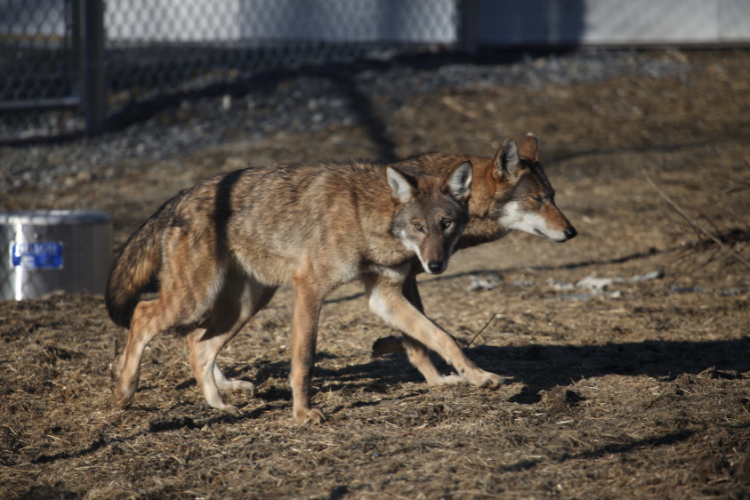
Feature image courtesy of Millbrook School.
She looked me in the eyes, and for about 10 seconds we had a complete, unspoken conversation.
She: Are you afraid?
Me: Yes, you?
She: Yes. Could you hurt me?
Me: Yes, but I don’t want to.
She: Same. If we fought, who would win?
Me: I’d rather not find out.
She: OK, let’s put a pin in that and come back to the question later if we need to.
The four of us had had lots of meetings together over the year, as we worked with architects, engineers, philanthropists and consultants to design a new animal hospital for our school. But I didn’t recognize the forms in the notebook; this wasn’t the animal hospital.
Three days earlier in the dining hall, I had joined my friends and colleagues, Alan, Jess and Kyleen, at their table. “Is this a meeting or just lunch?” I asked as I sat down, not much caring what the answer would be. They were writing and drawing something in a notebook. The four of us had had lots of meetings together over the year, as we worked with architects, engineers, philanthropists and consultants to design a new animal hospital for our school. But I didn’t recognize the forms in the notebook; this wasn’t the animal hospital.
“We can be in there for only 30 minutes, 45 max, before they’ll be too stressed. It’s too dangerous,” said Kyleen. Kyleen Depew, Millbrook’s director of animal care, is never this assertive unless she’s speaking for the animals, in which case she can be more than direct, even fierce. “These wolves are unpredictable, and under too much pressure they might hurt someone,” she explained.
An Endangered Species on Campus
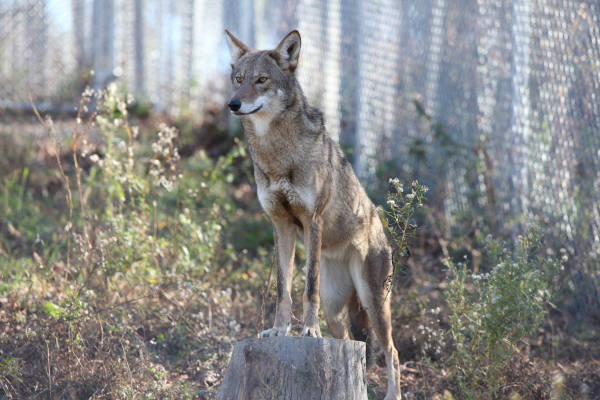 |
| One of the red wolves at the Trevor-Lovejoy Zoo at Millbrook School. |
The American Red Wolf is a critically endangered species. Only about 200 red wolves remain in the world, mostly living in captivity. They are managed by an SSP – that’s a species survival plan, to the uninitiated – which determines breeding pairs to prioritize genetic diversity, and, ideally, directs when and where animals should be released or “reintroduced” into the wild. Approximately 40 American Red Wolves exist in the wild, in the forests of North Carolina. Seven of those in captivity live in the Trevor-Lovejoy Zoo at Millbrook, the only high school in the world with a zoo.
“How can I help?” I asked the table, not fully thinking through the commitment I was making.
“Wear a hat and sturdy boots. We’ll start at 8:30,” said Alan.
Alan Tousignant has been a close friend almost since I met him, nearly 14 years ago. We share a love of the outdoors and a reverence for manual labor. We both discovered CrossFit at the same time, and although he’s logged a lot more miles than I have, he has always been my standard bearer in the gym. He’s the most brilliant, humblest, hardest-working man I’ve ever known. Alan is the zoo director at Millbrook School, a job title that makes him unique among both schools and among zoos.
Zoo Business
As CFO and general counsel, my dealings with the zoo are not normally as exotic as one might think. The zoo requires a special insurance policy, which thankfully is not wildly expensive. The staffing needs are unique — husbandry keepers don’t tend to come to independent school hiring fairs. Otherwise, to a CFO, it’s just a school program with expenses and revenues, not unlike the school store or the athletics department.
Millbrook students are very actively involved in animal care and enrichment. The zoo is a major draw for students and families interested in biology, veterinary medicine and environmental conservation. “Oh, Competitor School X does composting? We’re breeding endangered species. Want to help?” The zoo has capital projects, an annual fund and a donor base that includes alumni and also members of the visiting public. Open 365 days a year, we welcome 40,000 visitors annually.
Shifting the Wolves
Last spring, our breeding pair of wolves had a litter of four pups. Those pups are now fully grown, and the SSP will soon tell us which ones are staying, which are leaving to breed somewhere else, and which are destined for release into the wild. In the winter before that happens, they need to be separated for veterinary care and DNA sampling and to prevent inbreeding.
Separating the wolves or 'shifting' them, in zoo parlance, is the most human contact they will have, by a wide margin. Kyleen was right to be nervous.
Although the red wolves are “captive,” the animals are handled as little as possible. This discipline gives any wolf that will be released into the wild the best chance of survival. They will need a healthy skepticism of humans and sufficiently strong instincts to hunt and navigate on their own. Separating the wolves or “shifting” them, in zoo parlance, is the most human contact they will have, by a wide margin. Kyleen was right to be nervous.
On the day of the shift, I was one of 12 people in the wolf enclosure: Alan, Kyleen and Jess, the zoo’s deputy director; both zoo maintenance workers; all three husbandry keepers; a recent graduate who is now studying zoology at Cornell; the director of risk management; an office assistant and me. The goal was to corral the mother and four pups into the wolf house, where Jess would shift them one by one into individual pens.
The enclosure is about a quarter of an acre in total, with an eight-foot perimeter fence that has a two-foot security overhang, angled inward. Wolves can easily jump five to six feet vertically, and more with adrenaline. Our plan is for eight of us to form a human chain, with Alan out in front giving directions, Jess inside the wolf house, and Kyleen monitoring the animals and operating the radio.
The Moment of Truth
As we gathered outside the enclosure, even before entering, the wolves could sense something was about to happen. The mother ran directly at us, leapt six feet in the air, pushed off the fence with her hind feet and caught the security overhang with her front feet before twisting in the air and coming back to earth. She was showing us she was the boss and ready to protect her pack.
I’ve never had trouble focusing on a task – usually Excel spreadsheets or contract review – but stepping into the wolf enclosure helped me find a new gear. A bomb could have gone off outside that fence and I wouldn’t have noticed.
My job had been made clear to me: stay an equal distance between the people to my immediate left and right, and keep quiet. I’ve never had trouble focusing on a task – usually Excel spreadsheets or contract review – but stepping into the wolf enclosure helped me find a new gear. A bomb could have gone off outside that fence and I wouldn’t have noticed. There were only three things in the world: the woman to my left, the man to my right, and the wolves. Alan said, “One step forward,” and I obeyed.
There should be a word to describe the feeling you get when you watch someone you respect do something that requires incredible skill, and do it well. That word would reflect a mash-up of admiration, awe, pride and love. It’s what I feel when I see my wife, Sarah, teaching a photography class through her studio door, or when I hear Ben, the school’s physical plant director, talking to our general contractor about what ERV system to put in our new dormitory. And it’s what I felt in that moment, watching Alan in the wolf enclosure.
He gave us a direction, “Uphill side, take one step forward,” with his eyes darting from wolf to wolf, predicting how our movement would impact their behavior. When he talked, they listened. We all listened.
The first pups went into the wolf house pretty easily, wanting mostly to get away from the line of humans who had invaded their territory. As one ducked into the house, the door closed. We heard the sounds of sliding gates and some radio chatter, and the door opened again. Repeat, repeat.
After that, however, the three remaining wolves were more nervous, feeling separated and vulnerable. They backed toward one another, circling the wagons, facing out at us. “Everyone take one step. And another. And another,” said Alan. One more pup went in, the door closed, the door opened. “Come on, girl, go see where your brothers went,” Alan coaxed. She did. Door closed, door opened.
Kyleen was nervous, watching the last wolf, the mother, who was bigger, older, smarter and getting increasingly anxious. “Alan, do you see her tongue?” she noted. “Watch the veins in her back legs,” she urged, observing, “I don’t love her posture.” Kyleen, too, is exceptional at her job. “Come on, mama, go see your kids,” she urged again. The wolf, however, was not even thinking about going inside. Hackles up, squared off, her eyes were glued on us. On me.
Alan called it for the day. Four pups successfully shifted away from mom was a win. The zoo staff let her rest and recover, and they would try again tomorrow to shift her too. As we backed out of the enclosure, one step at a time, everyone’s anxiety meter dipped back below the red line. Safely outside, we debriefed the experience so that Alan, Jess and Kyleen could make adjustments to their procedure in the future. But now my focus is flagging, and I can’t help but look back over my shoulder at mother wolf. She is watching me, too.
Me: Truce?
She: Truce.
Power of the Pack
Kipling wrote, “The strength of the pack is the wolf, and the strength of the wolf is the pack.” These roles that we in the independent school business office fill are such a privilege: we work with talented people, are part of a team, play our part in our schools’ missions, and contribute to the wider world.
I’ve always enjoyed reading the “Other Duties as Assigned” column in Net Assets, in part because it’s fun to see my friends and colleagues celebrated for their contributions to their schools. But I also appreciate this space as a celebration of the nuances of financial and operational leadership. We take on wildly disparate “other duties as assigned” – like coaching a ski team, driving a toaster bus on weekend duty, leading a group to Habitat for Humanity, and yes, even wrangling wolves – because these experiences within the unique programs of each of our independent schools make us more aware of the connection between program and finance, and they make us more effective advocates for both.
I’m grateful for my wolf pack, and glad that my work can contribute to its success.
Editor's note: If you would like to share any "other duties as assigned" you undertake at your independent school, please contact Net Assets editorial staff at netassets@nboa.org. We'd love to hear from you!