NBOA President and CEO
Just last week I had the pleasure of meeting with the NBOA Board of Directors at our fall meeting, the timing of which roughly aligns with the board meetings you all conduct at your schools at this time of year. To be honest, getting 17 school business leaders and industry experts in the same room for three days in late September or early October was no mean feat, but the effort is always more than repaid with the thoughtful and provoking conversation. I can’t say enough how grateful I am for the NBOA Board’s strategic leadership — the association is in good hands.
On the note of governance, I’m sharing this space this week with a long-time independent school business leader, who also brings experience in higher education business, David Hanson, MBA, JD, Ed.D. Previously at the Branson School in California and Phillips Exeter Academy in New Hampshire, as well as Virginia Commonwealth University and Emory, Hanson is also founder of Winthrop & Associates.

Over the course of more than 25 years working in education, I have spent a great deal of time with boards and leadership teams at consequential moments. Sometimes the issue is financial: a structural deficit, softening enrollment, rising compensation costs, deferred facilities investment or a budget that has become increasingly difficult to balance. Sometimes it is organizational: a leadership transition, strategic planning process, fundraising challenge, governance concern or a community trying to determine what it wants its school to become. Often, what appears to be one problem is many interconnected problems.
That experience has led me to a simple conclusion: Well-trained boards create sustainable schools. And boards that are well intentioned but insufficiently prepared put schools at risk. That is not an indictment of trustees. Board members care deeply about their schools. They give their time, bring valuable experience, contribute financially and sincerely want the institution to succeed. The problem is that caring about a school and knowing how to govern one are not the same thing.
We understand that distinction almost everywhere else in education. We train teachers. We develop heads of school. We focus on student development. We expect business officers to understand increasingly sophisticated rules. Yet we routinely ask trustees to oversee multimillion-dollar (or billion-dollar) institutions, massive physical plants, complex employment structures, substantial financial risk, and long-term stewardship of a mission with virtually no training in how to govern any of it. That is no longer possible to justify.
The strongest boards I have worked with understand that their role has two dimensions: the “required” and the generative.
- Required governance Boards are required to exercise fiduciary oversight, approve budgets, hire and evaluate a head of school, oversee risk, protect mission, and vote on policies and controls. They must understand the distinction between governance and management. But that is the bare minimum.
- Generative governance goes further. Generative boards ask questions before those questions become urgent. They connect finance to strategy and market forces. They challenge assumptions. They consider different futures. They create the conditions for difficult decisions while choices still exist. That distinction is where I increasingly believe sustainable schools are made.
I have seen boards receive excellent financial reports and still not understand the basics of the “operating deficit” business model. The finance committee knows the numbers and the CFO explains budget variances: the board approves the budget. The required work is done. But the generative work rarely happens and that requires a very different type of board.
A pattern I have seen repeatedly is that problems do not arrive suddenly. They accumulate over many years. A board approves a slightly optimistic enrollment assumption or delays a facilities project. Staffing expands because a new program feels important or financial aid increases as affordability becomes more difficult. Annual giving covers a gap, but tuition still rises. Each decision is reasonable on its own.
Several years later, however, the school discovers that it has built a financial structure with little flexibility. Then enrollment softens or leadership changes, and what looks like a crisis emerges. But the crisis did not begin that year. It began when individually reasonable decisions were never considered collectively. That is precisely where a strong, well-trained, generative board adds value.
I believe five practices should be required of boards that want to create sustainable independent schools.
1. Continuous Trustee Education
A two-day rapid-fire board orientation or retreat is not enough. Trustee education must start during recruitment and require ongoing training during board service. All trustees do not need to become school-finance experts or enrollment strategists, but every trustee must gain enough fluency to govern intelligently. That means understanding:
- fiduciary responsibility
- the “operating gap”
- UPMIFA
- the school's financial model
- enrollment and financial aid
- compensation
- philanthropy
- facilities
- reserves
- risk
- appropriate relationship between the board and administration.
The required work is understanding how the school operates today, and the generative work is understanding what may change tomorrow. A board cannot govern an institution with knowledge acquired during a one-day orientation session.
Effective Financial Governance
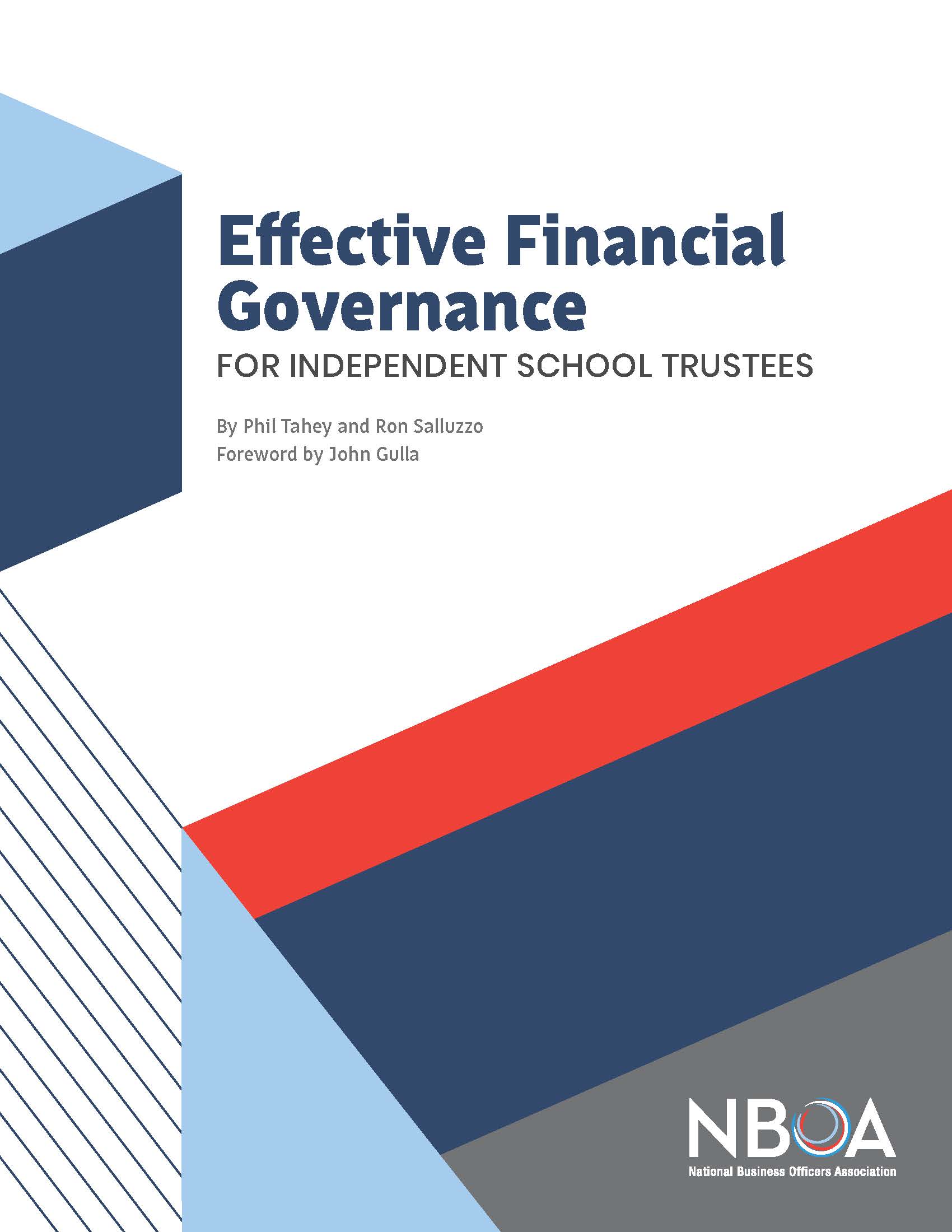 To better fulfill their fiduciary duties, boards of trustees and their finance committees often need education around the financial model and related drivers of K-12 nonprofit independent schools. This short book outlines key concepts, strategic considerations and questions for school administration.
Learn more and purchase. NBOA members receive a 40% discount.
2. Require Financial Literacy of Every Trustee
Financial literacy cannot live only in the finance committee, as the entire board is responsible for the financial sustainability of the institution. Every trustee must understand the basic relationship among enrollment, tuition, financial aid, staffing, compensation, fundraising, facilities, reserves and debt. They do not need to understand every line of the financial statements or Form 990, but they must understand the story the numbers are telling. In my experience, most board members do not. Financial literacy moves trustees from approving numbers to governing the decisions behind them.
3. Require Forward-Looking Indicators
Boards spend too much time looking backward. They review last quarter’s financials, last year’s enrollment, annual giving to date, etc. That work is required, but historical reporting does not create sustainability and generative boards know that. A generative board identifies a few indicators of where the institution is heading and, more importantly, establishes thresholds. At what enrollment level does the current staffing model become unsustainable? At what point does financial aid materially change net tuition revenue? What level of liquidity does the board consider a red flag? What happens if fundraising misses plan by 10%? These conversations give leaders choices before circumstances take those choices away. Good governance protects options.
4. Build the Board the Future School Requires
As the business model itself evolves, does the board include people capable of thinking strategically about economics, not simply reviewing financial statements?
Board recruitment should follow strategy. Too often, trustees are selected because they are enthusiastic parents, donors, respected alumni or successful professionals. Those qualities are not enough. The generative question is what capabilities the institution will need around the table during the next 5-10 years. As the business model itself evolves, does the board include people capable of thinking strategically about economics, not simply reviewing financial statements? A school should not discover after a challenge emerges that its governing body lacks the expertise required to understand it.
5. Require Periodic External Assessment
Boards may evaluate themselves, but self-assessment has significant limits. In my work I’ve repeatedly seen that boards often do not know what they do not know. Most boards view themselves as highly effective while still carrying significant blind spots around governance, finance, leadership support, board composition or strategic discipline. That is why periodic external assessment should be a required part of strong governance. We routinely test students, why not boards? An experienced independent third party can see what is difficult to see from inside the institution. They can challenge assumptions, compare practices, assess whether trustees understand the financial model, examine structures, evaluate composition, and identify gaps between how the board believes it operates and how the institution experiences its governance.
The required question is: Are we fulfilling our responsibilities? The generative question is: What are we unable to see about ourselves? The best boards ask both.

Jeffrey Shields, FASAE, CAE
NBOA President and CEO
Follow NBOA President and CEO Jeff Shields on LinkedIn.