NBOA President and CEO
The 100 days of May have officially begun! While you may be sprinting toward graduation and other end-of-school-year celebrations, I hope you’ll make time for some reflective work in the business office, taking stock of the year behind you before you look ahead to the next.
I once heard someone say, “Everything that matters can be measured, but not everything you measure matters.” This comment has stuck with me throughout the years, which is why I would urge you to make time for NBOA’s latest Financial State of the Industry report, released last month. For years this report has benchmarked the key ratios that truly matter to your school’s long-term financial health. And this year’s report offers even more that these time-tested data points.
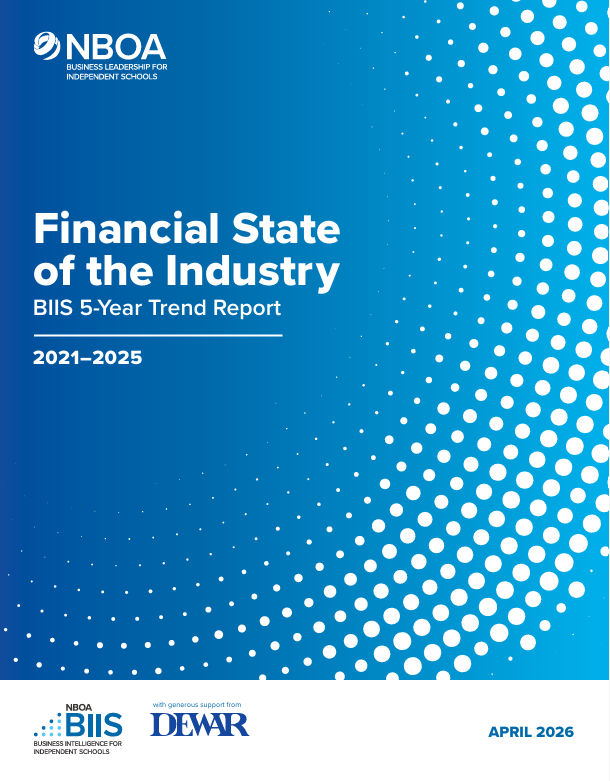
"Financial State of the Industry: BIIS Financial and Operational Indicators: 2021-2025" draws on five consecutive years of financial operations data, a period that coincides with NBOA’s DASL/BIIS partnership with NAIS, which streamlined data collection for schools and provided a more robust and cleaner set of data for analysis for both associations. That five-year period is also the five school years following the onset of the COVID pandemic. As such, this report offers a precise window into the impact of that crisis and its aftermath on school finances and operations.
In the midst of the pandemic, it was difficult to clearly see the full financial impact of that disruption. Now, with some distance from those crisis years and with multiple years of consistent data behind us, we can begin to see the story more clearly. Here are just a few of the report’s takeaways:
Strengths
- Enrollment and demand signals are generally positive, though market conditions are uneven.
- Net tuition revenue per student grew strongly thanks to annual increases in gross tuition and fees and moderation in financial aid.
- Capital investment is recovering after a slowdown during the early pandemic years.
Vulnerabilities
- Expense growth outpaced net tuition growth, widening the gap that must be covered by other revenue sources such as annual giving, endowment draw and/or auxiliary programs.
- Philanthropy trends are diverging with declines in lower-end gifts and gains in higher-end gifts, which can amplify inequities in schools’ ability to fund the growing gap.
- Deferred maintenance has increased, suggesting that schools should prioritize addressed improvements neglected during the pandemic.
The full report includes an executive summary as well as an analysis of 18 financial and operational indicators, with full color charts and brief explanations of each indicator’s importance. “Financial State of the Industry: BIIS Indicators 2021-25” is complimentary to NBOA member schools, and nonmembers can purchase it.
I also want to affirm that while national benchmarks are incredibly useful, context matters. Understanding how your school compares to peers and how your own trends are moving over time is just as important as understanding headline industry narratives. NBOA built the BIIS data analysis platform precisely for that reason so NBOA members can create custom cohorts and use tested tools like the NBOA Financial Dashboard and the NBOA Financial Sustainability Heat Map to asses their particular school’s financial position.
Finally, I want to clarify that data doesn’t replace judgment or mission-driven leadership, but it sharpens both. It helps boards ask better questions, supports more informed planning conversations among the administrative team, and grounds decision-making in reality rather than anecdote.
I’m deeply grateful to all of the schools that have contributed their data over the past five years. Their participation makes this kind of insight possible and strengthens the entire NBOA community in the process.
When you have a moment to reflect on the 2025-26 school year and begin thinking about what comes next, I encourage you to spend time with the report and with your own school’s data. I have no doubt that the story it tells is nuanced, instructive and well worth your attention.

Jeffrey Shields, FASAE, CAE
NBOA President and CEO
Follow NBOA President and CEO Jeff Shields on LinkedIn.