
In recent years, liquidity management has been facilitated by cash yields nearing 5%. Maintaining positions in cash and bonds proved advantageous, offering solid returns with comparatively lower risk. However, the recent downturn in interest rates will present greater challenges for nonprofit organizations regarding liquidity management. Reduced interest income is likely to affect operating budgets, while diminished bond yields will negatively influence endowment performance.
Within the endowment, institutions generally have two options to reduced yields. They can:
- Increase exposure to equities and illiquid assets to increase their likelihood of meeting long-term return targets; or
- Maintain their current risk profile, accept the possibility of lower returns and reduce their spending
Few institutions can afford to lower their spending rate or underperform their long-term target. To support future growth, institutions may need to rethink their liquidity profile and their allocation to bonds, moving along the investment spectrum toward risk/return options that best fit their risk profile. The following framework highlights how to think about your organization’s liquidity needs and weigh the inherent tradeoffs between liquidity and returns.
What is liquidity, and how is it measured?
Liquidity refers to the ease with which an asset (or security) can be converted into cash without affecting its market price. The easier an instrument is to convert to cash, the more liquid it is. Stocks and bonds can generally be liquidated to cash fairly readily, often daily. In a normal market environment, investors typically assume they will be able to sell them at a fair market-based price should they need liquidity.
However, liquidity can dry up in periods of market dislocation and investors may be forced to sell assets at discounted values. While this tends to happen infrequently, the consequences of a true liquidity crisis are dire, prompting nonprofits to take every measure to avoid it.
Are concerns about liquidity warranted?
No. Even having gone through three significant market crashes in the past 20 years, very few organizations — only those with highly levered endowments — have actually experienced liquidity crises. Instead, nonprofits are facing a return crisis. For the past decade, they have struggled to meet long-term return objectives. This jeopardizes their missions, since the endowment’s investment returns are what sustain the organization’s work in perpetuity.
The question is: How much liquidity do you actually need, and what are you giving up by prioritizing liquidity?
Liquidity's Opportunity Cost
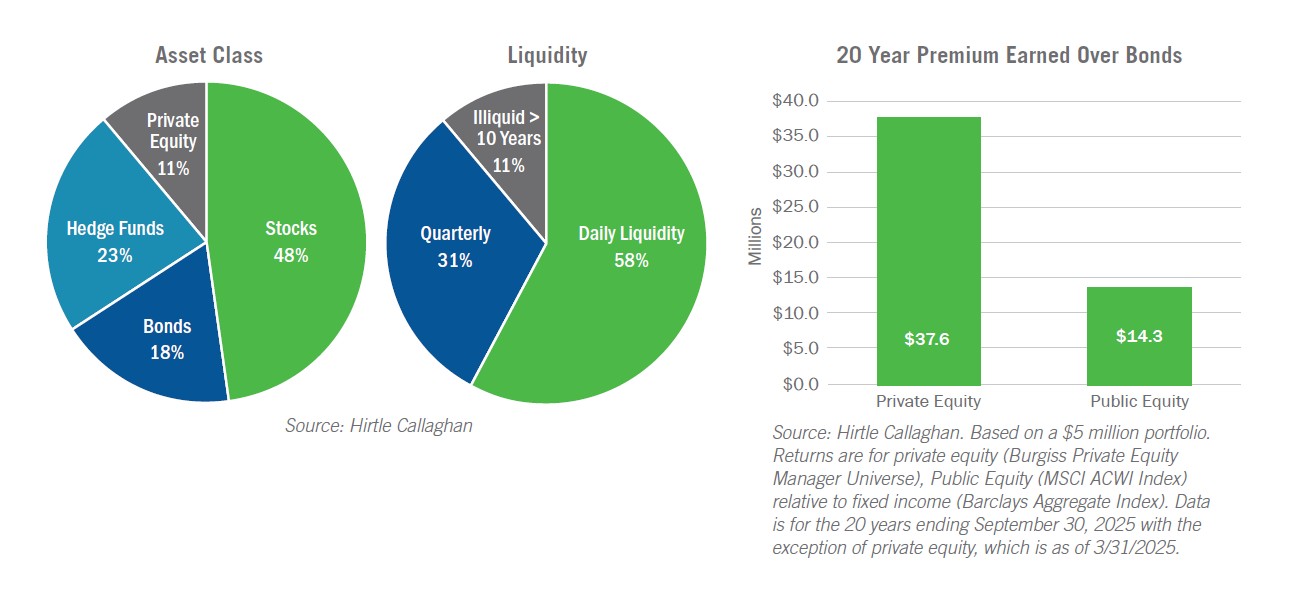
The chart below left depicts the liquidity profile for Nonprofit ABC’s endowment. Nonprofit ABC has 58% of its portfolio in daily liquid assets and 18% in bonds, which at first glance may seem very prudent. Many organizations pursue a similar strategy, favoring stability, income and diversification of bonds. However, it is important to note that there is very real opportunity cost associated with holding bonds relative to stocks and certain types of illiquid investments.
In the chart below right, the opportunity cost is quantified by calculating the excess return that we expect private equity and stocks to generate relative to bonds. Over the past 20 years, investments in private equity and publicly traded stocks generated $37.6 million and $14.3 million more, respectively, than an investment in bonds.
To sustain their endowment through a lower interest rate environment, organizations will have to look further afield to achieve higher returns. This may include increasing equity allocations or committing to asset classes such as private equity, which offers the potential for outsized returns for those willing and able to commit capital for longer periods. Yet, there is often resistance from nonprofit boards to adding illiquidity, even when they are aware of the opportunity cost of not doing so.
Are illiquid investments really illiquid?
To help get boards comfortable with the idea of illiquidity, it helps to clarify that liquidity is a spectrum. For example, the private equity allocation is treated as illiquid, yet private equity investments involve extensive cash flows, initially funding new investments and ultimately returning capital as those investments mature.
The chart below depicts Hirtle Callaghan’s cash flows model for a typical private equity fund investment. On average, in the sixth year of a private equity fund commitment, the cash flows turn positive with realized gains exceeding the upfront capital called to make the underlying investments. And in the first four years before a private equity investment becomes cash flow positive, the net cash outflow is approximately 65% of the total committed capital. A mature private equity program should be cash flow generative in a normal market environment.
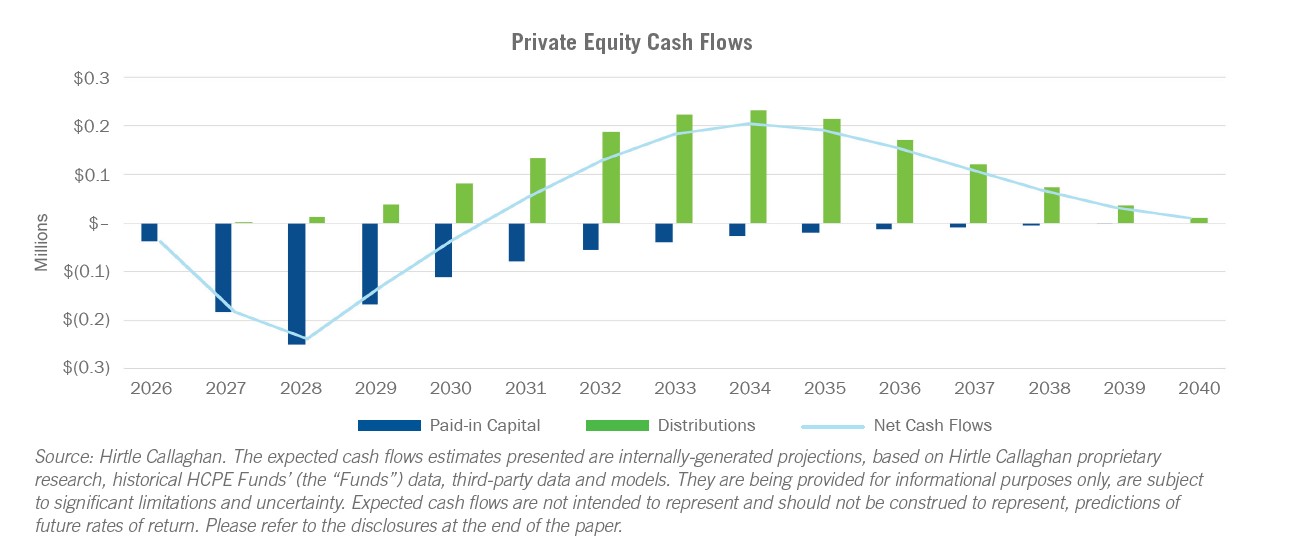
Organizations that have built a consistent private equity allocation over time should have the benefit of mature private equity vintages returning capital and generating positive cash flow as newer vintages are calling capital. This self-perpetuating liquidity structure should provide some security if constructed properly.
How much liquidity do you need?
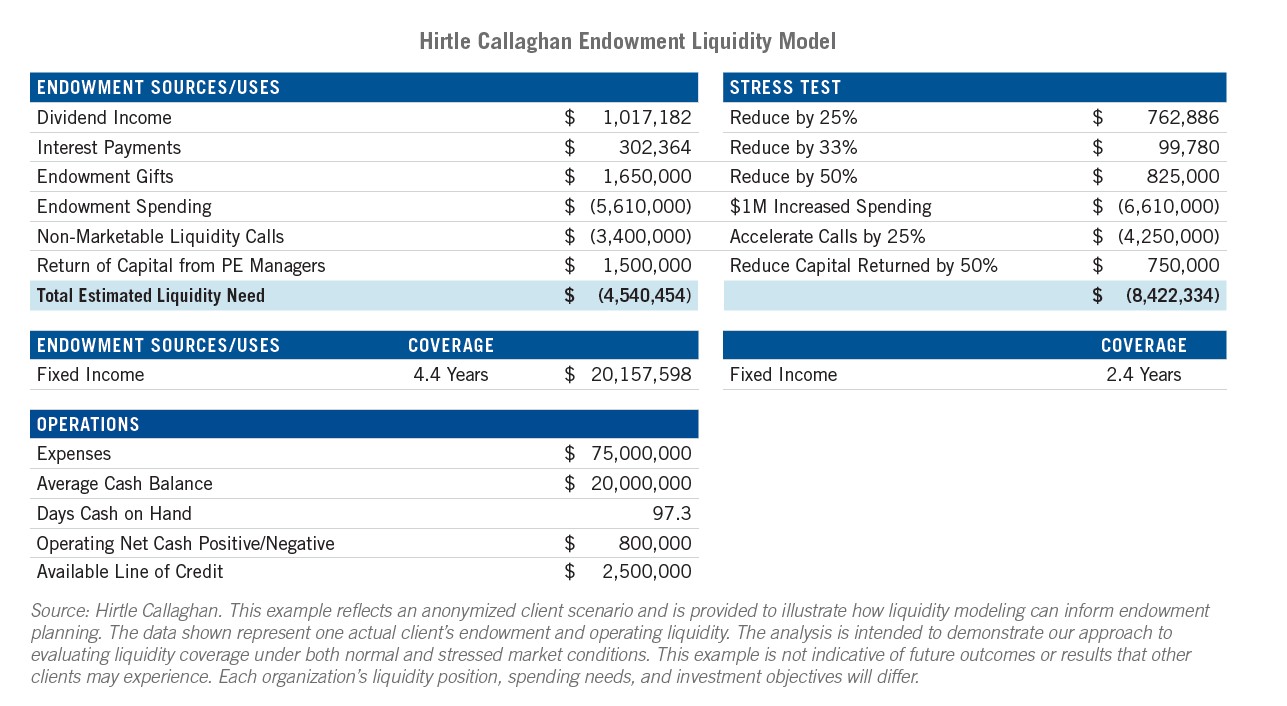
Traditional liquidity measures don’t meet modern nonprofits’ needs, as they focus exclusively on asset classes and disregard cashflows. When undertaking a liquidity analysis, it is prudent to look at the organization’s operating model, including sources and uses of cash. Key questions include how much liquidity is required, projected endowment spending, non-marketable calls, special draws, and how income sources offset these demands. Factoring in these variables significantly alters Nonprofit ABC’s liquidity profile, as shown in the table below.
At Hirtle Callaghan, we believe organizations should always maintain a minimum of two years of liquidity in the endowment to ensure a proper buffer to weather any prolonged market crisis. Liquidity over this threshold has the potential to dampen the endowment’s returns and threaten the long-term viability of the organization.
In the case of Nonprofit ABC, with $20.2 million in fixed income, it can cover 4.4 years before needing to sell equities, allowing time for market recovery. Even with reduced income estimates ― dividends down 25%, interest 33%, and endowment gifts 50% ― the bond portfolio still covers 2.4 years. This means that if the market crashed this portfolio has 2.4 years of liquidity before equities would need to be liquidated.
It is also important to incorporate Nonprofit ABC’s operating liquidity into the model. Its net operating surplus, operating reserve and line of credit show that operations are cash positive with 97 days cash on hand. In the event of a downturn, it is unlikely that operations will need additional liquidity from the endowment beside the annual draw. Nonprofit ABC’s average cash balance of $20 million compared to the $4.5 million total estimated net liquidity need suggests that in the event of a liquidity crisis, operations could forgo the draw until liquidity improved. This organization has a strong liquidity profile.
When viewed against the question of how much liquidity is appropriate, Nonprofit ABC appears to be over-emphasizing liquidity at the expense of its endowment growth. Adding more illiquidity in the form of private equity has the potential to enhance long-term returns, strengthen the endowment and ultimately offer more support to the organization’s mission.
What are the legal restrictions?
The final step of the liquidity review is to understand your endowment’s legal restrictions. Restricted endowments (assets endowed by the donor) are subject to the Uniform Prudent Management of Institutional Funds Act (“UPMIFA”). This act mandates that a restricted endowment’s investing and spending must be at a rate that will preserve the purchasing power of the principal over the long term. As a result, excess liquidity in a restricted endowment, while comforting, is largely unusable, except to make the annual spending withdraw.
Maintaining highly liquid assets in your restricted endowment does not significantly improve your organization’s liquidity profile and may be an unnecessary drag on returns.
From a liquidity perspective, the board designated quasi endowment is the only endowment assets you can legally spend down to address a significant operating or capital issue. Maintaining highly liquid assets in your restricted endowment does not significantly improve your organization’s liquidity profile and may be an unnecessary drag on returns.
The Importance of Purchasing Power
The biggest risk most endowments face today is not illiquidity, but the failure to maintain purchasing power. For organizations highly dependent on endowment income, this will permanently reduce the impact your organization will have in the future. Nonprofit leaders need to carefully balance the tradeoff between current liquidity and long-term investment returns. While liquidity enables organizations to meet operating needs, fund commitments and meet planned capital expenditures, too much liquidity can prevent them from realizing their long-term growth potential.