NBOA President and CEO
When we talk about the financial health of an independent school, it’s prudent to review the balance sheet or operating ratios. But perhaps a more meaningful starting point is a relationship: the partnership between the head of school and the business officer.
Just last week I had the pleasure of moderating a panel, “Partnering for Success: Securing the Future Health of Your School,” at the annual conference of The Association of Boarding Schools, here in my hometown of Washington, DC. I’ve had the pleasure of attending the TABS conference many times, and it’s always rewarding to take a deep dive into all things boarding, which is a valuable and unique offering within independent education. NBOA Directors Ed Griffin and Carolyn Hapeman presented alongside their heads of school at St. George’s School and Westtown School, respectively.
The head-business officer relationship was at the center of the questions we brought to that session. But with an audience that also included student life, enrollment and residential life professionals, it was clear that the principles of partnership that were discussed apply across a school’s leadership team. These were our questions:
- How do leaders build trust?
- How do they navigate competing priorities?
- How do they help trustees make decisions that serve both today’s students and the school’s long-term future?
These are not simply financial questions. They are not boarding-school specific questions. They are leadership questions, and the business officer is at the center.
Collectively, we sought to drive home this point: A business officer’s responsibility is not merely to report what a school can afford or explain why a specific program proposal may not be feasible. It is to help shape the choices presented before the school: clarify assumptions, connect decisions across departments, surface risks early and identify paths that make mission possible. Financial expertise is essential, and its greatest value comes when it informs schoolwide judgment and upholds the school’s mission.
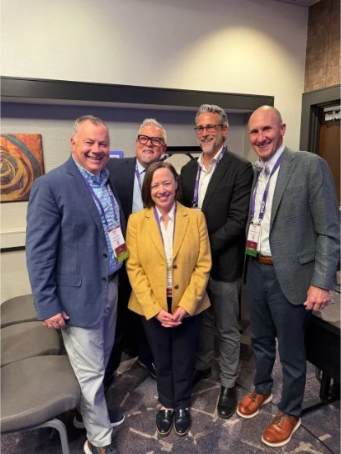
Jeff Shields with NBOA Board members Ed Griffin and Carolyn Hapeman, CPA, along with their heads of school Michael Wirtz and Chris Benbow.
Decisions Informed by Partnership
Consider enrollment and financial aid. A net tuition revenue goal cannot be separated from the community a school seeks to build. Neither can a change in the day–boarding mix be understood only as a budget adjustment. Each choice carries implications for programs, staffing, student experience and identity. The business officer should help leaders see those connections before a decision is made, not only calculate the consequences afterward.This calls for curiosity as well as technical skill. That means uncovering what the school is really trying accomplish and what assumptions warrant testing. That kind of thinking moves the conversation beyond a familiar — and less effective in my opinion — division between the head as guardian of mission and the business officer as guardian of money. It’s undeniable that both leaders bear responsibility for your school’s future.
Trust makes candor possible
A strategic partnership does not require agreement at every turn. It requires enough trust to name differences and work through them. Affordability and sustainability, tradition and innovation, immediate needs and long-term investment were all areas we discussed that can pull leaders in different directions. The goal is not to eliminate that tension, the panel affirmed, but to make it a productive aspect of informed decision-making.
To that end, my colleagues reminded me that “no surprises” is a good mantra, even if it means frequent communications. One panelist shared that “over communicating is essential in an independent school environment” because we are always responding to multiple constituent needs (students, faculty, administration, trustees and parents) with every decision. Frequent communication, clear ownership and early discussion of emerging concerns allow each leader to challenge the other without undermining the relationship. A business officer should be willing to bring forward an uncomfortable question, for example, “Is there a reason to do this in the current fiscal year?” and equally willing to reconsider an initial answer when colleagues offer a new perspective.
That partnership also shapes board engagement. Together, the head and business officer can build trustees’ understanding before a consequential decision is made. Rather than overwhelm trustees with detail or present a recommendation without context, they can explain the tradeoffs, distinguish operational questions from governance responsibilities and keep the discussion focused on the school’s strategic direction, ultimately, the future.
Seeing the whole school
The boarding school environment makes the human dimension of business leadership especially necessary, visible and consequential. In this environment, faculty staff wear multiple hats. I’m reminded of a tagline I saw in the exhibit hall that simply stated: “teach, coach, live.” Faculty housing, residential staffing and campus life are not isolated expense categories — they shape the community in which people work, learn and raise families. A decision that appears efficient on paper may carry consequences that become clear only when leaders listen across the school. As one panelist noted, at a boarding school, your supervisor or colleague may also be your neighbor, bringing the operational and personal aspects of school life together.
For heads and business officers, a useful next conversation may be a simple one: Are we bringing business leadership into decisions early enough to help shape them?
The “humanist CFO,” as framed by St. George’s head of school, Michael Wirtz, is a useful way to describe this broader responsibility. This means exercising financial discipline with an understanding of people, culture and the school’s purpose.
For heads and business officers, a useful next conversation may be a simple one: Are we bringing business leadership into decisions early enough to help shape them? The strongest partnership is not one in which the business officer always says yes, or the head always accepts the financial recommendation. It is one in which both leaders can question, listen and decide together, with a shared responsibility for the school they are building.
It was clear from the panel that a strong partnership is essential to a boarding school’s long-term financial health. That means fostering an environment among your leadership where different opinions, perspectives, insights and ideas are valued as a source of strategic strength for your school.

Jeffrey Shields, FASAE, CAE
NBOA President and CEO
Follow NBOA President and CEO Jeff Shields on LinkedIn.